Partnership for Economic Policy: PEP News

from September 2026

📍local evidence for local solutions

This month’s newsletter highlights how PEP-supported research is informing policy discussions—from financing solar irrigation to shaping public spending and improving learning. Explore training opportunities, new publications and developing-country perspectives on AI.

One month left: register now for PEP’s 2027 online courses in Applied Development Economics
Register by 31 October 2026

PEP  is offering five online Applied Development Economics courses, in English and French,  from February  to May 2027. These include a new course on Advanced CGE Modelling.

The courses provide advanced training in these cutting-edge concepts and methodologies:

  1. Non-experimental impact analysis
  2. Computable General Equilibrium Modelling
  3. Measuring and Alleviating Poverty and Inequality
  4. Gender Analysis in Economic Policy Research
  5. New for 2027 | Advanced Computable General Equilibrium Modelling 

The courses are provided in collaboration with the University of Florence in Italy, the awarding institution.

Find out more & apply

​​​​​​​

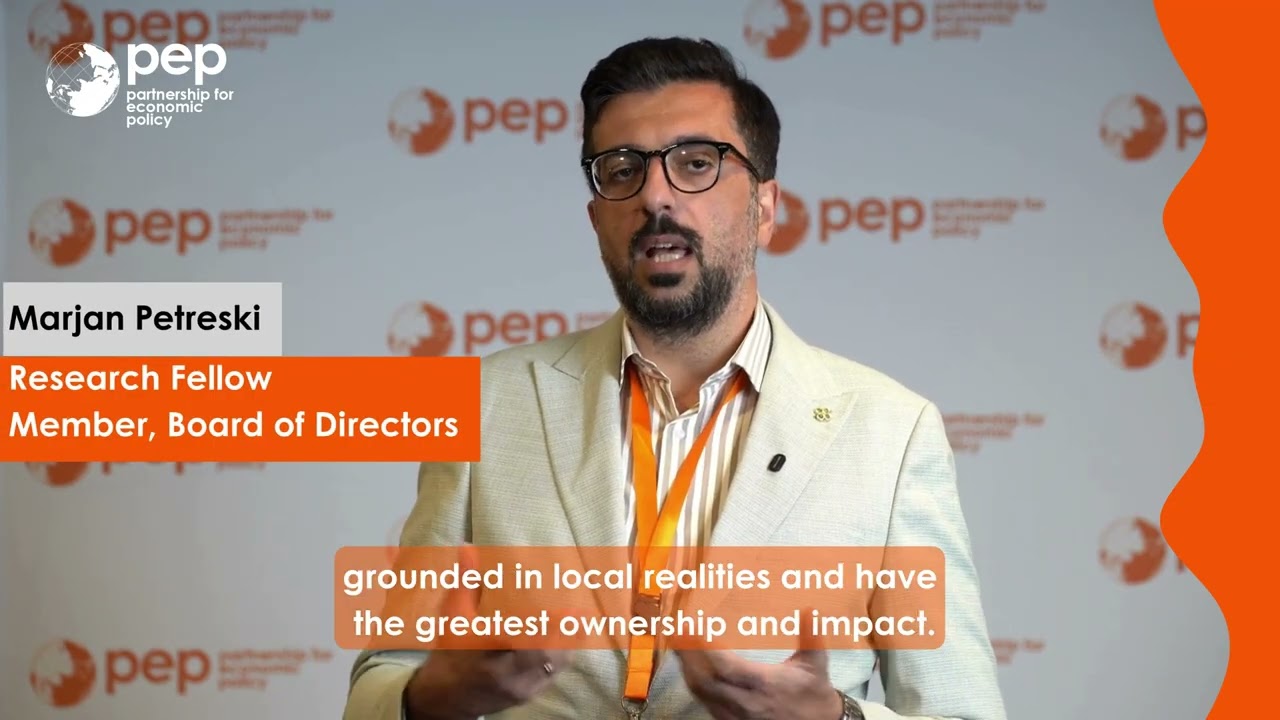
Video | Moving Beyond Publication towards Policy Influence

Marjan Petreski, PEP Research Fellow and Board Member, reflects on PEP’s role in supporting researchers to move beyond publication towards meaningful policy influence.

​​​​​​​
Events
Participants at the national conference on solar pumping in Burkina Faso, held at Université Joseph KI-ZERBO in Ouagadougou.

Burkina Faso Agriculture Officials Request Recommendations on Solar Irrigation

Burkina Faso’s agriculture ministry requested a written summary of recommendations from a PEP-supported National Policy Conference to help expand solar irrigation without increasing dependence on imported equipment and services.

Read More

Participants and speakers at the CEDCA National Policy Conference on clean energy for development in Uganda.

Uganda Energy Ministry Commits to Act on Research into Low-Carbon Agricultural Technologies

Uganda’s Energy Ministry pledged to use evidence-based recommendations from PEP-supported research to refine regulatory frameworks and support an inclusive low-carbon transition.

Read more

Group photo of participants at the Kenya National Policy Conference, convened to discuss research findings and policy options for improving access to solar irrigation systems among smallholder farmers in Kenya.

Kenya Conference Connects Agricultural Finance and Solar Irrigation Stakeholders

At a National Policy Conference convened by local PEP-supported researchers, Kenya’s public-sector agricultural financier and a solar irrigation provider opened a dialogue to help smallholder farmers overcome the cost barrier to adopting solar irrigation systems.

Read More

Participants at the Beyond GDP event in Ottawa on 15 September 2026. PEP Executive Director Prof. Jane Mariara joined the roundtable online.

PEP calls for beyond GDP measures to shape budget decisions

At an international discussion on measuring progress beyond GDP, PEP's Executive Director called for broader measures of well-being, equity, and sustainability to shape public spending.

Read more

PEP research fellow Verónica Amarante (second from left) speaks at the Global Forum for AI and the Social Sciences in London. Also on the panel was Haroon Bhorat (right), who served on PEP’s Board of Directors from 2017 to 2022

PEP Research Fellow brings developing-country perspectives to AI forum.

PEP Research Fellow VerĂłnica Amarante highlighted how gaps in skills, infrastructure, and access to technology could limit the benefits of generative AI in developing countries.

Read More

Prof Jane Mariara

At a care economy webinar, PEP highlights barriers to women’s clean energy adoption

PEP's Executive Director highlighted findings showing that knowledge or interest is insufficient when women lack the financial means or authority to influence household investments in clean energy.

Read more

News
New Book

New Book: Navigating Transitions to Sustainable Human Development

Co-authored by PEP researchers and staff, this open access title explores what is needed for policy to support more equitable and sustainable societies.

Read more and download

Gender Equality and Inclusion for High-Quality Research

New home for PEP’s Gender Equality & Inclusion training

Collaboration with SDG Academy ensures this self-paced, bilingual course remains available and free to access, strengthening researchers’ capabilities to embed GEI principles in their research.

Read More

A mother teaching a child at home using solar energy lamp

Blog | Energy at Home Can Support Learning, but It Is Not Enough

Expanding energy access can improve the conditions in which children learn. However, infrastructure can only create an opportunity. 

Manuella Ndjakwa, a Fellow of the African Fellows in Education Program, shares her findings from Cameroon and discusses how energy access and parental homework support can work together to improve learning.

Read more

Cover of 2025 PEP Annual Report: Locally led research supporting better futures

Read the 2025 PEP Annual Report

Explore this dedicated webspace to discover highlights of the progress, outputs, and impact generated through PEP’s support and activities in 2025.

Read more

Stock photo of a meeting room in Africa. One person (mostly out of shot) is speaking, the others are looking in the speaker's direction and clapping and smiling

Southern Lens on Development
Newsletter by Prof. Jane Mariara

Have you explored Southern Lens on Development yet?

PEP Executive Director Prof. Jane Mariara shares her insights on how Southern voices are shaping sustainable development solutions.

Now also available on the PEP blog.

Read more and subscribe

Findings
a-mother-supporting-her-child-s-reading-at-home

Cameroon’s Rural Energy Expansion Offers an Opportunity to Improve Learning Conditions for Primary School Pupils

Primary school pupils in rural Cameroon face poorer learning outcomes than their urban peers. Using nationally representative 2019 PASEC data for 4,723 Grade 6 pupils in 272 schools, PEP researcher Manuella Ndjakwa examined how household energy access and parental homework support relate to reading and numeracy. She found that energy access is associated with stronger reading performance but not improved average numeracy. The benefits are greatest among higher-performing pupils, suggesting that energy expansion alone may leave struggling learners behind. However, parental support may make gains more inclusive: maternal support is linked to better numeracy among initially low-performing pupils, while paternal support is associated with modest reading gains. The study recommends piloting coordinated energy-access and parental-support interventions in underserved rural communities before national scale-up.

Find out more in Policy Brief 316 | Project page 

Information workshop on solar water pumps conducted in treatment villages in Dak Lak Province(1)

Promoting Solar Water Pump Adoption among Smallholder Farmers in Vietnam: Beyond Information Campaigns

Despite their potential to reduce irrigation costs and support low-carbon agriculture, adoption of solar water pumps remains low among smallholder farmers in Vietnam. A team of PEP-supported researchers evaluated whether limited information about the costs, benefits and technical characteristics of the technology was contributing to this low uptake. The study found no significant increase in adoption, willingness to pay, agricultural production or profits following the information workshops. Instead, financial constraints emerged as the main barrier, with around 40% of non-adopting households citing insufficient resources as their primary reason for not purchasing a pump. The findings highlight the need to complement information and agricultural extension services with affordable financing options, such as concessional loans, and to test these approaches before scaling nationally.

Find out more in Policy Brief 315 | Project page

Publications
Opportunities

PEP also shares opportunities and events from the development research community that may be of interest to our members. PEP is not involved in the organisation of the following calls/activities. Contact the organisers directly for any further information.

Opportunités pour les francophones:

More opportunities


Thank you for subscribing to the PEP newsletter. You can keep up to date with our latest activities and publications throughout the month on LinkedIn, Bluesky, Instagram and Facebook.