BULLETIN No 15 - AOÛT 2026

Cette veille scientifique de l’INESSS a comme objectif de nourrir la réflexion sur l’impact environnemental des systèmes de santé et sur les considérations environnementales en évaluation des technologies en santé (ETS). Chaque bulletin présente une sélection de publications, issues des littératures scientifique et grise, organisée en trois axes :

Sources

PubMed, MEDLINE, Embase, CINAHL Complete, HealthcareLCA, GreenFILE, sites Web d’organisations en évaluation des technologies de la santé et d’associations pour la santé environnementale (dernière mise à jour : 2026-07-23).

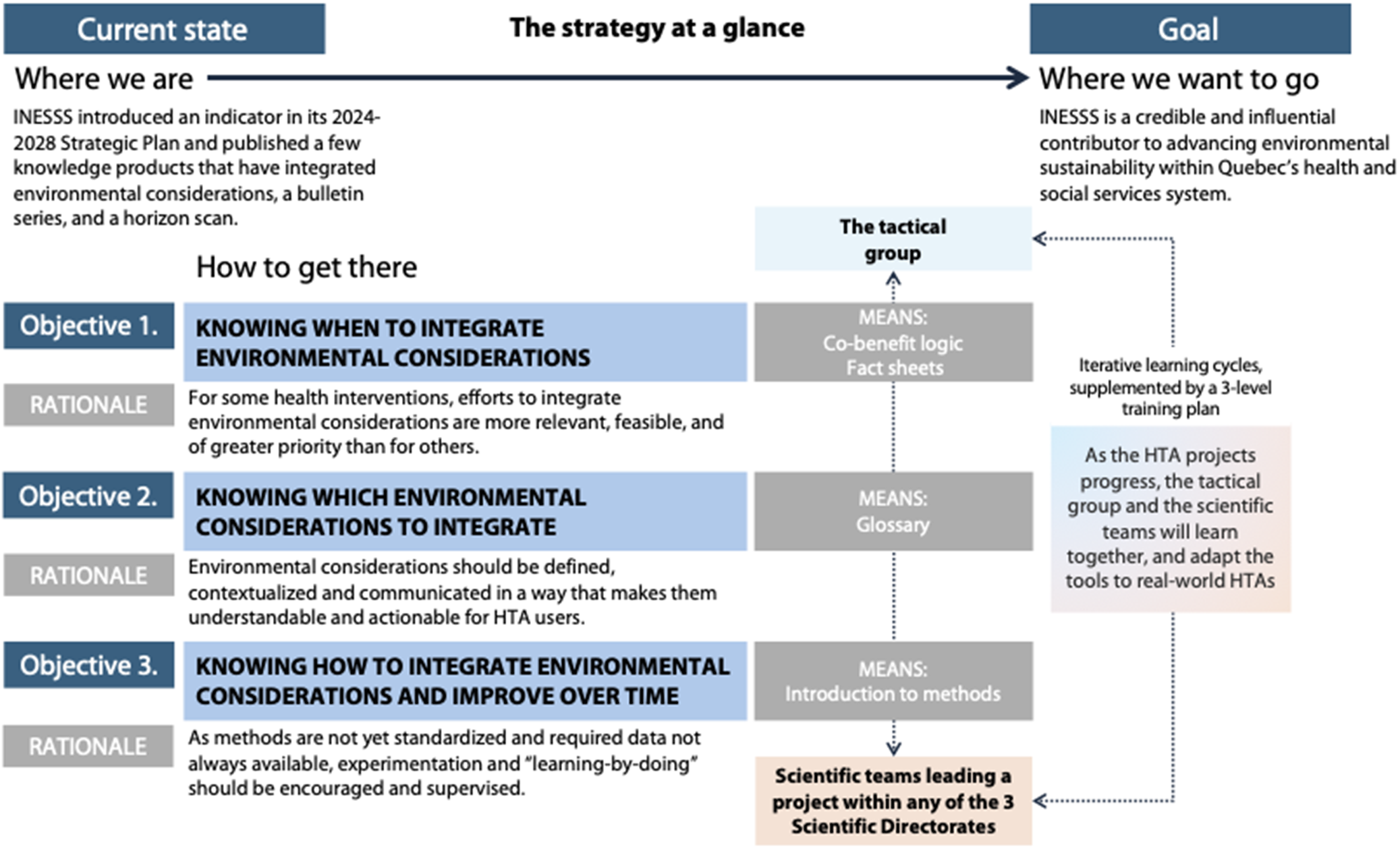
Integrating environmental considerations in HTA: The strategy of the Institut national d’excellence en santé et services sociaux (INESSS)
International Journal of Technology Assessment in Health Care (juillet 2026)

Image : The goal, objectives, rationales, and means of the strategy.

Source : Lehoux et al. (2026)

Next-generation methods in health technology assessment (HTA): Need, rigor, and implementability
International Journal of Technology Assessment in Health Care (juillet 2026)

Image : Summary of the need, rigor, and implementability of environmental sustainability, adaptive HTA, and AI and RWE in HTA.

Source : Richardson et al. (2026)

Sous-thématiques

A primer on Scope 3 emissions Category 1: Purchased goods and services
Canadian Coalition for Green Health Care et MaRS Discovery District (juin 2026)

Five years of Greener NHS: Improved carbon footprint assessment of the National Health Service in England
The Lancet – Planetary Health (mai 2026)

Image : Diagram of the emission sources included in the National Health Service Carbon Footprint (NHSCF) and National Health Service Carbon Footprint Plus (NHSCF+) and how they relate to the GHG Protocol scopes.

Source : Simpson et al. (2026)

Towards a greener pharmaceuticals' regulatory highway: A framework for regulators as enablers of decarbonization
World Health Organization (juillet 2026) : « This framework provides a roadmap for how pharmaceutical regulatory systems can support innovation that reduces the climate impact of medicines for human use while maintaining standards of safety, quality and efficacy and ensuring timely, affordable and equitable access for patients. »

First studies funded under initiative to decarbonise health and social care
National Institute for Health and Care Research (juillet 2026)

MHRA approves world's first lower-carbon beclometasone inhalers for patients with asthma
Medicines and Healthcare products Regulatory Agency (juillet 2026)

The healthcare leaders' handbook for setting decarbonisation targets
Health Care Without Harm – Europe (juin 2026)

Au Canada

Decarbonization in action: Implementing climate solutions in Canadian hospitals
Canadian Coalition for Green Health Care (juillet 2026)

Canadian Medicine Carbon Footprint (MCF) Formulary
Canadian Coalition for Green Health Care (juin 2026) Créer un compte : « The Canadian MCF Formulary provides MCF Ratings for about 800 medicines that are frequently prescribed in Canada, covering the cardiovascular system, anti-infectives for systemic use, nervous system, and the alimentary tract and metabolism. The Canadian MCF Formulary is a free educational tool designed to encourage awareness and research about the carbon emissions of common medicines. It is not a clinical decision-making tool. »

Le gouvernement du Canada accorde plus de 17 millions de dollars pour lutter contre les répercussions des changements climatiques sur la santé
Santé Canada (juin 2026) : « Ce programme comprend deux volets : des systèmes de santé résilients aux changements climatiques et à faibles émissions de carbone (ADAPTATIONSanté) ; et, la protection des personnes au Canada contre les vagues de chaleur extrême (ADAPTATIONChaleur). »

Sustainable electronics in health technology - Using environmental life cycle assessments for circular business models
Cleaner Environmental Systems (mai 2026)

Image : Identified areas that influence LCA integration into CBMs.

Source : Abedi et al. (2026)

Sous-thématiques

Environmental footprint of peritoneal dialysis in Europe: A comparative life cycle assessment across four European centres
Clinical Kidney Journal (juin 2026)

Image : The environmental footprint of peritoneal dialysis in Europe: A comparative life cycle assessment across four European centres.

Source : Fehintola et al. (2026)

Artificial intelligence in dermatology: Clinical promise and environmental impact
Journal of Investigative Dermatology (juin 2026)

Image : AI in dermatology: Promise vs. Planet.

Source : Shen et al. (2026)

Archives du bulletin de veille scientifique
 

Avis de non-responsabilité

Les veilles scientifiques de l'INESSS contiennent des liens vers des sites Web dont la propriété et la responsabilité incombent à de tierces parties. L'accès aux liens fournis dépend de l'environnement technologique de l'utilisateur. L'INESSS n'assume aucune responsabilité à l'égard des contenus des sites Web externes.

Cette veille peut être utilisée, reproduite, imprimée, partagée et communiquée en tout ou en partie à des fins non commerciales, éducatives ou de recherche uniquement, à condition que l’INESSS soit dûment mentionné comme source.

Accès aux publications

Contactez votre institution pour connaitre les modalités d’accès aux publications qui renvoient à des abonnements payants.

Nous joindre

Faites-nous part de vos questions ou de vos commentaires.